Data Contracts: The Upstream Team Changed a Column and Didn't Tell You
A column gets renamed. A number becomes text. A field quietly starts arriving empty. Data contracts turn silent breakages into conversations that happen before deployment, not after the dashboard is wrong.
Monday Morning, 9:14 AM
Picture a scenario that will feel familiar to anyone who has run a data platform. The revenue dashboard shows a sharp overnight drop. Finance escalates. The data team spends the morning checking the pipeline, which ran successfully. The transformation models, which passed. The warehouse, which is healthy. Three hours later, someone finds it: in a Friday release, the application team renamed order_total to order_amount_cents and switched it from dollars to cents. The ingestion job didn't fail. It just loaded nulls into the old column, and the dashboard dutifully summed them.
Here's the uncomfortable part: by their own standards, nobody did anything wrong. The application team improved their schema, tested their service, and shipped. The data team's pipeline did exactly what it was built to do. The failure lived in the gap between them, in an interface that everyone depended on and nobody had defined.
The upstream team didn't break your pipeline. They changed their own system, which is their job. The problem is that nobody had ever promised you anything.
Why This Keeps Happening
In most organizations, analytical data is a byproduct of operational systems. Product teams own their databases and design them to serve the application. Data teams read from those databases through change data capture, extracts, or event streams. To the producer, the schema is an internal implementation detail they should be free to change. To the consumer, it's an API that half the business depends on. That mismatch guarantees breakage.
- ●Renamed or dropped columns that downstream models still reference.
- ●Type changes, such as an integer ID becoming a string UUID, or a number becoming free text.
- ●Unit and meaning changes: dollars to cents, UTC to local time, or a quiet redefinition of what "active" means.
- ●New category values that downstream logic doesn't handle and silently drops into an "other" bucket.
- ●Fields that start arriving empty because a form field became optional.
- ●Grain changes, where one row per order becomes one row per order line and every total doubles.
The most dangerous changes are the ones that don't break anything. A failed job gets fixed within the hour. A silently wrong number can drive decisions for weeks.
What a Data Contract Actually Is
A data contract is an explicit, versioned agreement between the team that produces a dataset and the teams that consume it. It is to data what an API specification is to a service: a published interface that the producer commits to, and that both sides can test against. A useful contract covers four things.
Schema
Field names, data types, required fields, keys, and allowed values. The structural shape of the data.
Semantics
What each field actually means, including units, time zones, and business definitions. Is revenue gross or net? Before or after refunds?
Quality and freshness
Expectations such as uniqueness, valid ranges, completeness, and maximum delay between an event happening and the data arriving.
Ownership and change process
Who owns the data, how to reach them, and how breaking changes are announced, versioned, and phased in.
What One Looks Like
Contracts are usually written in YAML or JSON and live in version control next to the code that produces the data. Open specifications such as the Open Data Contract Standard exist if you want a common format. The example below is simplified for readability, but it contains everything that would have prevented our Monday morning incident.
dataset: orders
version: 2.1.0
owner:
  team: checkout-platform
  contact: "#checkout-data"
description: One row per completed customer order.
grain: order_id
freshness:
  max_delay: 30m

schema:
  - name: order_id
    type: string
    required: true
    unique: true
  - name: customer_id
    type: string
    required: true
  - name: order_total
    type: decimal(12,2)
    required: true
    unit: USD
    description: Gross order value incl. tax, before refunds.
    checks:
      - min: 0
  - name: status
    type: string
    allowed_values: [placed, paid, shipped, delivered, cancelled]
  - name: created_at
    type: timestamp
    timezone: UTC

change_policy:
  breaking_change: major version + 30 days notice + parallel run
  deprecation_window: 60d
Nothing here is exotic. The value isn't in the format. It's in writing the expectations down, agreeing on them, and having a machine check them on every change.
Enforcement Is the Whole Point
A contract that lives in a wiki is documentation, and documentation drifts. Contracts deliver value when they're enforced automatically, at as many of these points as you can manage.
- 01
In the producer's CI/CD
A schema change that violates the contract fails the build, exactly like a breaking API change would. This is the highest-leverage point because it stops the problem before it ships.
- 02
At ingestion
Validate incoming data against the contract. Quarantine or reject batches that violate it instead of loading them silently.
- 03
In transformation
Encode contract expectations as tests in dbt or your transformation layer, so downstream models fail loudly when an assumption breaks.
- 04
In monitoring
Track freshness, volume, and distributions against the contracted expectations, and route alerts to the owning team, not only to the data team.
Breaking vs. Non-Breaking Changes
A good contract doesn't freeze the producer's schema. It distinguishes changes that are safe to ship at any time from changes that require a new version, notice, and a migration window.
| Usually safe | Breaking | |
|---|---|---|
| Columns | Adding a new optional column | Removing or renaming a column |
| Types | Widening a type, such as int to bigint | Narrowing or changing a type, such as number to text |
| Values | Adding documentation or stricter tests | Changing units or meaning; adding category values consumers don't handle |
| Nullability | Making an optional field always populated | Making a required field optional |
| Grain | Publishing a new, separate dataset | Changing what a single row represents |
Columns
- Usually safe
- Adding a new optional column
- Breaking
- Removing or renaming a column
Types
- Usually safe
- Widening a type, such as int to bigint
- Breaking
- Narrowing or changing a type, such as number to text
Values
- Usually safe
- Adding documentation or stricter tests
- Breaking
- Changing units or meaning; adding category values consumers don't handle
Nullability
- Usually safe
- Making an optional field always populated
- Breaking
- Making a required field optional
Grain
- Usually safe
- Publishing a new, separate dataset
- Breaking
- Changing what a single row represents
Semantic versioning works well here. Additive changes are minor versions. Breaking changes are major versions, published alongside the old version for an agreed period so consumers can migrate on their own schedule rather than discovering the change in production.
The Hard Part Is Social
Data contracts shift responsibility upstream, and producers often resist because it looks like extra work for someone else's benefit. That resistance is reasonable, and it's best addressed by making contracts cheap. Generate the first draft from the existing schema. Put the checks in the producer's existing CI pipeline. Keep the contract in their repository, owned by them. Show them the incident history so the cost of the status quo is visible.
Leadership has a role too. If data consumers aren't treated as real customers of the producing team, no YAML file will change behavior. When the revenue report is understood to depend on the checkout service's data as much as the checkout page does, contracts stop feeling like bureaucracy and start feeling like basic engineering hygiene.
A data contract is a technical artifact that solves an organizational problem. Get the incentives right and the YAML is the easy part.
How to Start Without Boiling the Ocean
- ●Pick one dataset whose breakage has hurt you. Usually it's the one behind revenue reporting or a customer-facing model.
- ●Contract only the fields that downstream consumers actually use. Fifty columns nobody reads are wasted effort.
- ●Name an owner on each side, with a real channel for change requests and questions.
- ●Add enforcement in one place first, ideally the producer's CI. Ingestion-time validation is the fallback.
- ●Measure incidents and time-to-resolution before and after. That number is how you fund the next ten contracts.
The Bottom Line
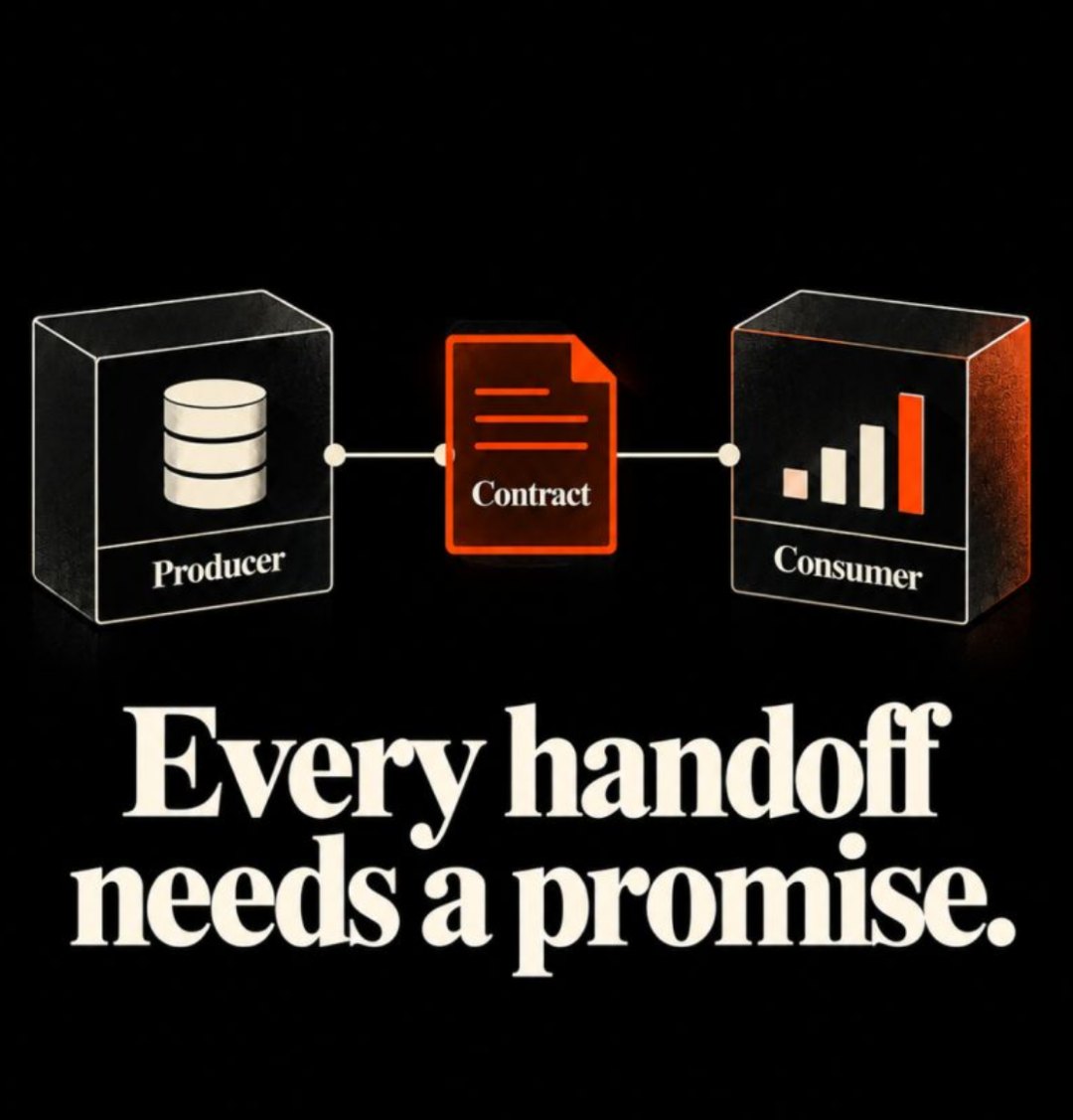
Every handoff needs a promise. Between services, we figured this out years ago with API specifications, versioning, and contract tests. Data handoffs deserve the same discipline, because the systems downstream of them, from finance reporting to production machine learning, are just as critical as any service.
At InclinedPlane, we help teams introduce data contracts that producers actually adopt: practical, automated, and focused on the handful of datasets where a silent change costs the most.