Data Gravity: Why Your Architecture Follows Your Data, Not the Other Way Around
As data accumulates, it pulls applications, services, and teams toward it. Fighting that pull is expensive. Designing for it is one of the most underrated decisions in data architecture.
A Pattern That Catches Companies Off Guard
It usually starts with a series of sensible, independent decisions. The application runs on one cloud because that's where the engineering team had experience. The CRM is a SaaS product. The analytics team chose a warehouse on a different provider because they liked its features. A year later, the AI team picks a platform on a third, because it had the best models at the time.
Two years in, the picture looks different. Nightly jobs copy terabytes between platforms, and they keep getting longer. Network charges have become one of the fastest-growing lines on the cloud bill. The CRM, the warehouse, and the AI platform each hold a slightly different version of the customer. And the AI project that was supposed to transform customer service is blocked, not on modeling, but on getting access to fresh, governed data. Nobody designed this architecture. The data designed it.
You don't really choose your architecture. You choose where your data lives, and the architecture follows.
Where the Idea Comes From
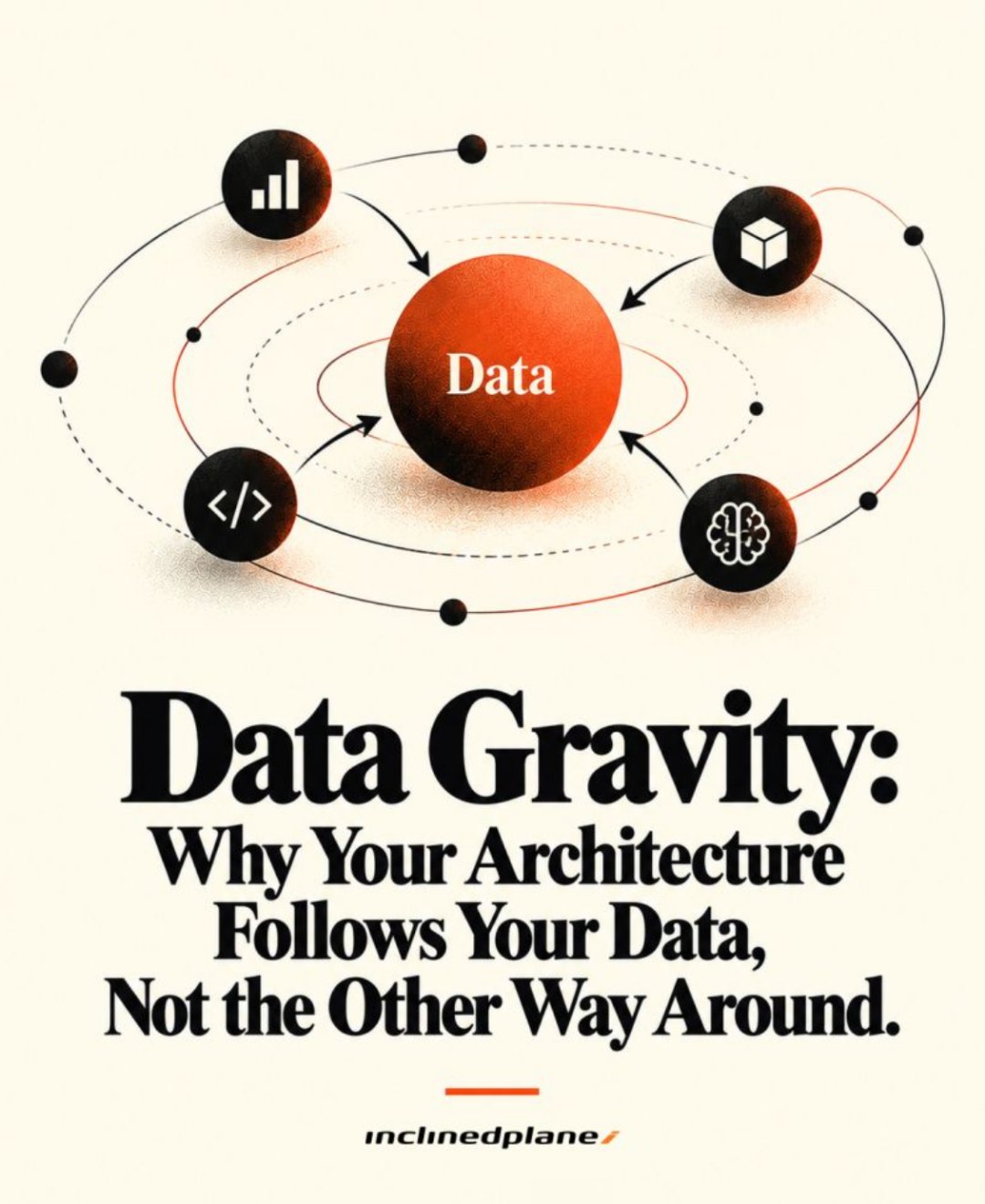
The term data gravity was coined by engineer Dave McCrory in 2010. His analogy was simple: like mass in physics, data has gravity. As a dataset grows, it becomes harder to move, and the applications and services that use it are drawn closer to it, because proximity means lower latency and higher throughput. Those applications generate more data, which increases the mass, which increases the pull. It's a feedback loop, and it has only become stronger as data volumes and AI workloads have grown.
The Forces Behind the Pull
Latency
Every network hop adds delay. Applications that query data constantly perform best when they sit close to it, ideally on the same platform and in the same region.
Bandwidth and time
Moving terabytes takes hours. Moving petabytes can take weeks, or physical transfer appliances. The bigger the dataset, the harder it is to move at all.
Egress costs
Cloud providers typically make it cheap to bring data in and charge to send it out. Every cross-cloud or cross-region copy becomes a recurring line item.
Compliance and sovereignty
Privacy and residency rules constrain where personal data can go. Every copy is another system to secure, audit, and include in deletion requests.
There's a fifth force that's easy to underestimate: trust. Once dashboards, models, and teams are built around one source, it becomes the trusted version of the truth. Moving the data means moving everything and everyone that depends on it, which is why the last 20% of so many migrations takes longer than the first 80%.
How Gravity Shows Up on Your Bill
Fighting data gravity rarely fails dramatically. It shows up as a slow accumulation of cost and friction. These are the symptoms we look for when assessing an architecture.
- ●Network and egress charges growing faster than compute or storage spend.
- ●Copy and sync jobs between platforms that take longer every quarter.
- ●Multiple sources of truth that disagree because they were refreshed at different times.
- ●Analytics and AI projects blocked on data access and movement rather than on the actual analysis.
- ●A migration that has been "almost done" for a year, because the remaining piece is the data everything else depends on.
Move Compute to Data, Not Data to Compute
If there's one principle to take from data gravity, it's this. For most of the last two decades, the default pattern was to extract data from where it lived and load it somewhere else to work on it. Modern platforms make the opposite pattern practical.
Warehouses and lakehouses now run Python, machine learning, and vector search next to the data. Zero-copy sharing features such as Snowflake Secure Data Sharing and Delta Sharing let other teams and even other organizations query data without receiving a copy. Open table formats like Apache Iceberg and Delta Lake let multiple engines read the same files in object storage, so choosing a new query engine no longer means duplicating the data. Federated queries can join across sources without a replication pipeline.
Every copy of your data is a liability with a maintenance schedule. Before building a pipeline that moves data, ask whether you could move the query instead.
Gravity Gets Stronger With AI
AI workloads amplify data gravity in several ways at once. Training and fine-tuning need large volumes of data. Retrieval-augmented generation needs fresh, low-latency access to documents and tables. Embeddings and vector indexes create entirely new derived datasets that themselves have to live somewhere.
The common anti-pattern is to stand up a separate AI platform and copy data into it. The copies go stale, so the assistant answers with last week's numbers. Worse, copied data usually loses the access controls of its source, so a chatbot can surface information to people who were never allowed to see it. The more durable pattern is to bring models to the governed data platform, keep embeddings close to their sources, and have AI applications inherit the permissions that already exist.
Designing With Gravity, Not Against It
- 01
Find your center of mass
Measure where your largest, most-queried, and most-joined data actually lives. That is your gravitational center, whether anyone planned it or not.
- 02
Co-locate heavy consumers
Put analytics, model training, and data-intensive applications on the same platform and in the same region as the core data wherever you can.
- 03
Prefer sharing and federation over copying
Reach for zero-copy sharing, open table formats, and federated queries before building a replication pipeline.
- 04
Make every copy deliberate
When you must replicate for latency, resilience, or residency, give each copy an owner, a freshness target, and a plan for retiring it.
- 05
Price the pull before choosing a platform
Include egress, replication, and the future cost of moving out in every platform decision, not just headline compute and storage prices.
When to Push Back Against Gravity
Data gravity is a force to design around, not a law that forbids distribution. There are good reasons to keep data apart. Residency regulations may require that certain data stays in a specific country or region. Edge workloads in factories, retail stores, and connected devices often need to process data locally and send only summaries to the center. Resilience and disaster recovery require copies by definition. And concentrating everything on one platform creates lock-in that deserves an honest conversation.
The answer in each case is to distribute deliberately. Process at the edge and send aggregates. Keep regional data in regional stores, and federate queries across them. Use open formats so that the cost of leaving a platform stays manageable. Gravity is easier to live with when you can still reach escape velocity if you need to.
| Fighting gravity | Designing with gravity | |
|---|---|---|
| Default pattern | Extract data and move it to wherever the tool runs | Run the tool where the data already lives |
| Copies | Created ad hoc, rarely retired | Deliberate, owned, and given a freshness target |
| Platform choice | Driven by individual team preference | Driven by where the center of mass is |
| AI workloads | Separate platform fed by copies | Models brought to governed data |
| Cost profile | Egress and sync costs grow quietly | Movement is minimized and priced up front |
Default pattern
- Fighting gravity
- Extract data and move it to wherever the tool runs
- Designing with gravity
- Run the tool where the data already lives
Copies
- Fighting gravity
- Created ad hoc, rarely retired
- Designing with gravity
- Deliberate, owned, and given a freshness target
Platform choice
- Fighting gravity
- Driven by individual team preference
- Designing with gravity
- Driven by where the center of mass is
AI workloads
- Fighting gravity
- Separate platform fed by copies
- Designing with gravity
- Models brought to governed data
Cost profile
- Fighting gravity
- Egress and sync costs grow quietly
- Designing with gravity
- Movement is minimized and priced up front
The Bottom Line
Data gravity is one of those forces that's invisible in any single decision and unmistakable in the aggregate. Every architecture eventually reorganizes itself around its data. The only question is whether that happens by design, or through years of copy jobs, surprise bills, and stalled migrations.
At InclinedPlane, we help organizations find their center of mass and design data platforms that work with the pull instead of against it, so that analytics, applications, and AI all get closer to the data rather than further away.