Data Stewards vs. Data Engineers: Why Conflating the Two Roles Slows Everyone Down
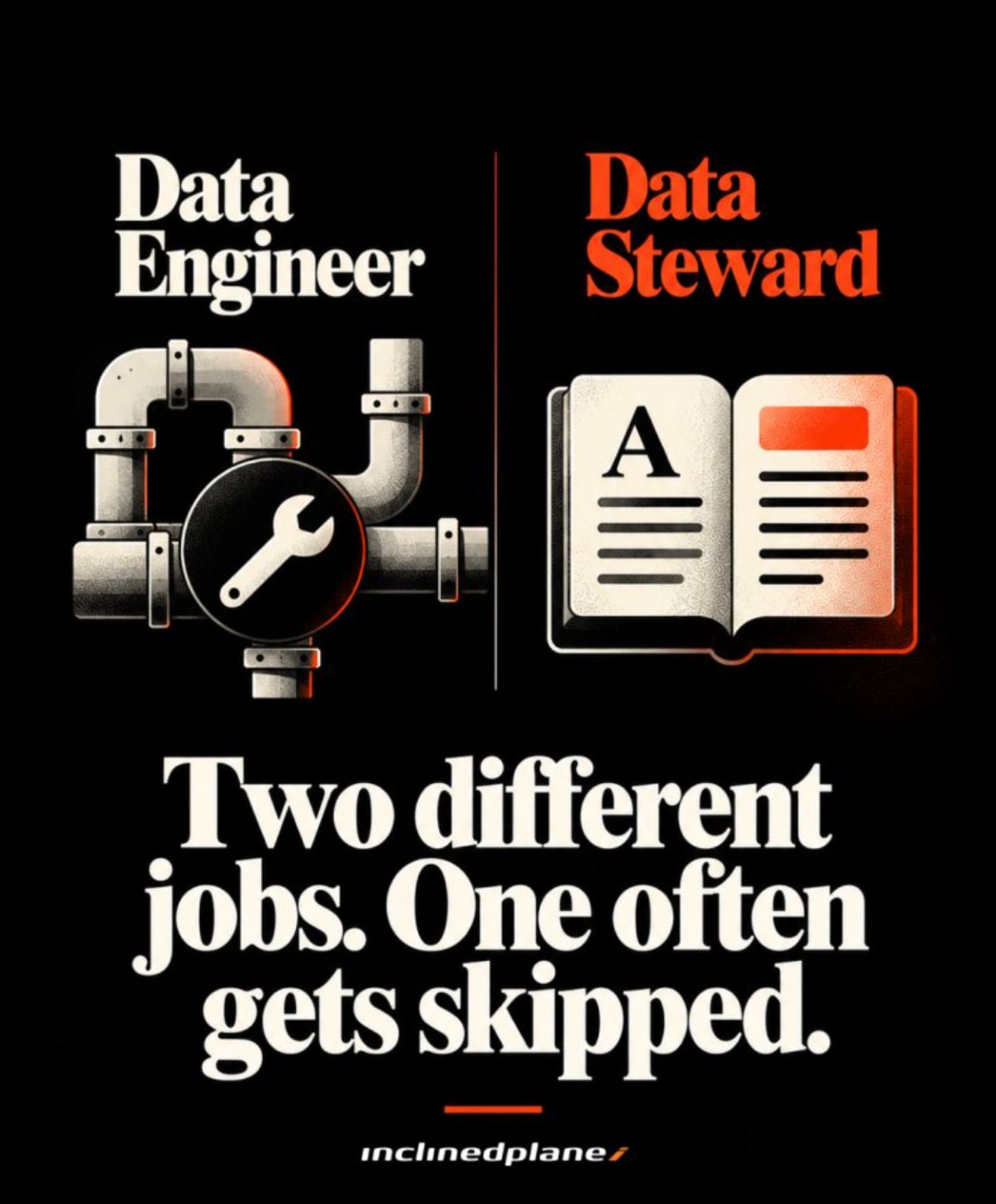
One builds the pipes. The other decides what flows through them and what it means. When organizations treat them as the same job, one of them quietly stops getting done.
Two Different Jobs
Read enough data job descriptions and a pattern emerges. A posting for a data engineer lists Spark, dbt, Airflow, and cloud infrastructure, and then, a few bullets down, adds: maintain the business glossary, own data quality, manage data access policies, and align with business stakeholders on metric definitions. Or a governance initiative launches and assigns stewardship of every dataset to the data team, on the reasoning that they know the data best.
They do know the data best, in one specific sense. They know the tables, the joins, the lineage, and where every column comes from. What they usually don't know, and shouldn't be expected to decide, is what the data should mean to the business. Those are two different kinds of knowledge, and two different jobs.
Data engineers know how the data moves. Data stewards know what the data means. You need both, and they are rarely the same person.
What a Data Engineer Does
Data engineering is the discipline of building and operating the systems that collect, move, transform, and serve data. A data engineer's day is spent on questions of how: how to ingest this source reliably, how to model it efficiently, how to make it fast and affordable to query, and how to know immediately when something breaks.
- ●Design and build ingestion, transformation, and serving pipelines.
- ●Choose and operate storage, compute, and orchestration infrastructure.
- ●Implement automated data quality checks, monitoring, and alerting.
- ●Optimize performance and cost as volumes grow.
- ●Automate testing, deployment, and recovery so the platform runs without heroics.
What a Data Steward Does
Data stewardship is accountability for data as a business asset. The DAMA Data Management Body of Knowledge, the standard reference for the field, frames stewardship around accountability and responsibility for data and the processes that ensure it is controlled and used effectively. In practice, stewards answer questions of what and whether: what does this field mean, is this value correct, and should this person be allowed to use this data for this purpose?
- ●Define business terms and maintain the glossary: what counts as an active customer, how net revenue is calculated, when an order is considered complete.
- ●Set quality rules and acceptable thresholds based on business impact.
- ●Decide who can access which data and for what purpose, in line with policy and regulation.
- ●Triage data issues to their root cause, which is often a business process rather than code.
- ●Approve changes to critical definitions and communicate them to everyone who depends on them.
Effective stewards usually sit in the business, close to where data is created or relied on. Finance stewards financial definitions. Sales operations stewards pipeline data. HR stewards people data. They have the context and the authority that a central data team, however capable, does not.
Side by Side
| Data Engineer | Data Steward | |
|---|---|---|
| Core question | How do we move, store, and transform this data reliably? | What does this data mean, is it right, and who should use it? |
| Owns | Pipelines, infrastructure, performance, and automation | Definitions, quality rules, access decisions, and business context |
| Typical home | Data or platform engineering team | The business domain that creates or relies on the data |
| Fixes problems by | Changing code, configuration, or infrastructure | Clarifying definitions, correcting processes, and resolving ownership |
| Success looks like | Pipelines are fast, reliable, and cost-efficient | Data is trusted, consistently defined, and used appropriately |
| Key tools | SQL, Python, Spark, dbt, orchestration, cloud platforms | Data catalog, business glossary, quality scorecards, policies |
Core question
- Data Engineer
- How do we move, store, and transform this data reliably?
- Data Steward
- What does this data mean, is it right, and who should use it?
Owns
- Data Engineer
- Pipelines, infrastructure, performance, and automation
- Data Steward
- Definitions, quality rules, access decisions, and business context
Typical home
- Data Engineer
- Data or platform engineering team
- Data Steward
- The business domain that creates or relies on the data
Fixes problems by
- Data Engineer
- Changing code, configuration, or infrastructure
- Data Steward
- Clarifying definitions, correcting processes, and resolving ownership
Success looks like
- Data Engineer
- Pipelines are fast, reliable, and cost-efficient
- Data Steward
- Data is trusted, consistently defined, and used appropriately
Key tools
- Data Engineer
- SQL, Python, Spark, dbt, orchestration, cloud platforms
- Data Steward
- Data catalog, business glossary, quality scorecards, policies
Why One Often Gets Skipped
When one person or team is responsible for both, the outcome is predictable. Engineering work has deadlines, tickets, and outages that page people at 2 AM. Stewardship work, such as agreeing on a definition across three departments or chasing down why one region's numbers look odd, is slow, cross-functional, sometimes political, and never pages anyone. Urgent beats important every single time.
So stewardship doesn't disappear. It happens implicitly, inside the engineering work, by whoever happens to be writing the code. An engineer decides which of two conflicting CRM fields is the real industry. Another deduplicates customer records using matching rules nobody in the business ever approved. A third defines churn inside a SQL transformation because a dashboard was due on Friday. Each choice is reasonable in isolation. Together, they mean critical business definitions are being made invisibly, without authority, and without anyone accountable for them.
If nobody owns the definition of "customer", your data engineers do, one CASE statement at a time.
The Symptoms of Missing Stewardship
- ●Three dashboards show three different numbers for the same metric, and a meeting is scheduled to decide which one is right.
- ●Data quality alerts fire into a channel where nobody is accountable for acting on them.
- ●Access requests wait for weeks because nobody has the authority to approve them.
- ●A business glossary was started with enthusiasm and hasn't been updated since.
- ●Data engineers spend a growing share of their time answering "what does this field mean?" instead of building.
- ●AI initiatives stall because nobody can confirm which data is accurate and approved for training.
Making the Two Roles Work Together
The fix isn't a large governance program. Heavyweight programs tend to produce committees and documents rather than better data. What works is smaller and more practical.
- 01
Name stewards for critical domains, not all data
Start with the handful of datasets behind your most important metrics and decisions. Revenue, customers, and products are the usual first candidates.
- 02
Make stewardship part of an existing role, with real time
A finance analyst who spends a defined slice of their week stewarding revenue data is often more effective than a dedicated governance hire with no domain authority.
- 03
Define decision rights explicitly
Stewards decide what a metric means and what quality level is acceptable. Engineers decide how to implement, automate, and enforce it. Write this down.
- 04
Turn stewardship decisions into engineering artifacts
Definitions become semantic layer metrics. Quality rules become automated tests. Access decisions become policies. Expectations between teams become data contracts.
- 05
Create a regular working rhythm
A short recurring review of open data issues, upcoming changes, and definition requests keeps both sides aligned and stops problems from piling up.
Stewardship in the Age of AI
AI raises the stakes on everything above. Models amplify inconsistent definitions at scale. A natural-language analytics assistant that queries your warehouse will confidently return whichever of the three revenue definitions it finds first. Training data needs an approved purpose, documented lineage, and someone accountable for whether it's representative.
Data engineers can build the retrieval pipeline, the feature store, and the training infrastructure. But only a steward can say whether HR data may be used to train a model, which customer records are reliable enough to learn from, or what "eligible" means in a benefits policy. AI makes stewardship more necessary, not less.
The Bottom Line
Two different jobs. One often gets skipped. Data engineering without stewardship produces fast, reliable pipelines delivering numbers nobody fully trusts. Stewardship without engineering produces careful definitions that never make it into the systems people use. The organizations that get value from their data give each role its own owner and connect them with clear decision rights.
At InclinedPlane, we build the engineering foundation and help organizations put lightweight, effective stewardship around it, so the data that flows through the pipes is data the business can actually stand behind.