Explainability: Why “The Model Said So” Isn't an Answer
A loan gets declined. A claim gets flagged. A shipment gets rerouted. If nobody can say why, you don't have an AI system. You have a liability with an API.
Three Decisions, One Question
A loan application is declined. An insurance claim is flagged for fraud review. A shipment is rerouted through a different warehouse overnight. Each of these decisions was made in milliseconds by a model, and each one lands on a person: an applicant, a claims adjuster, a logistics planner, a customer waiting for a delivery. All of them eventually ask the same question. Why?
"The model said so" is the most common answer and the least acceptable one. Not because models are inherently untrustworthy, but because an answer nobody can interrogate is an answer nobody can correct. If you can't explain a decision, you can't defend it to a regulator, you can't help the customer change the outcome, and you can't tell whether the model is right for the right reasons or right by accident.
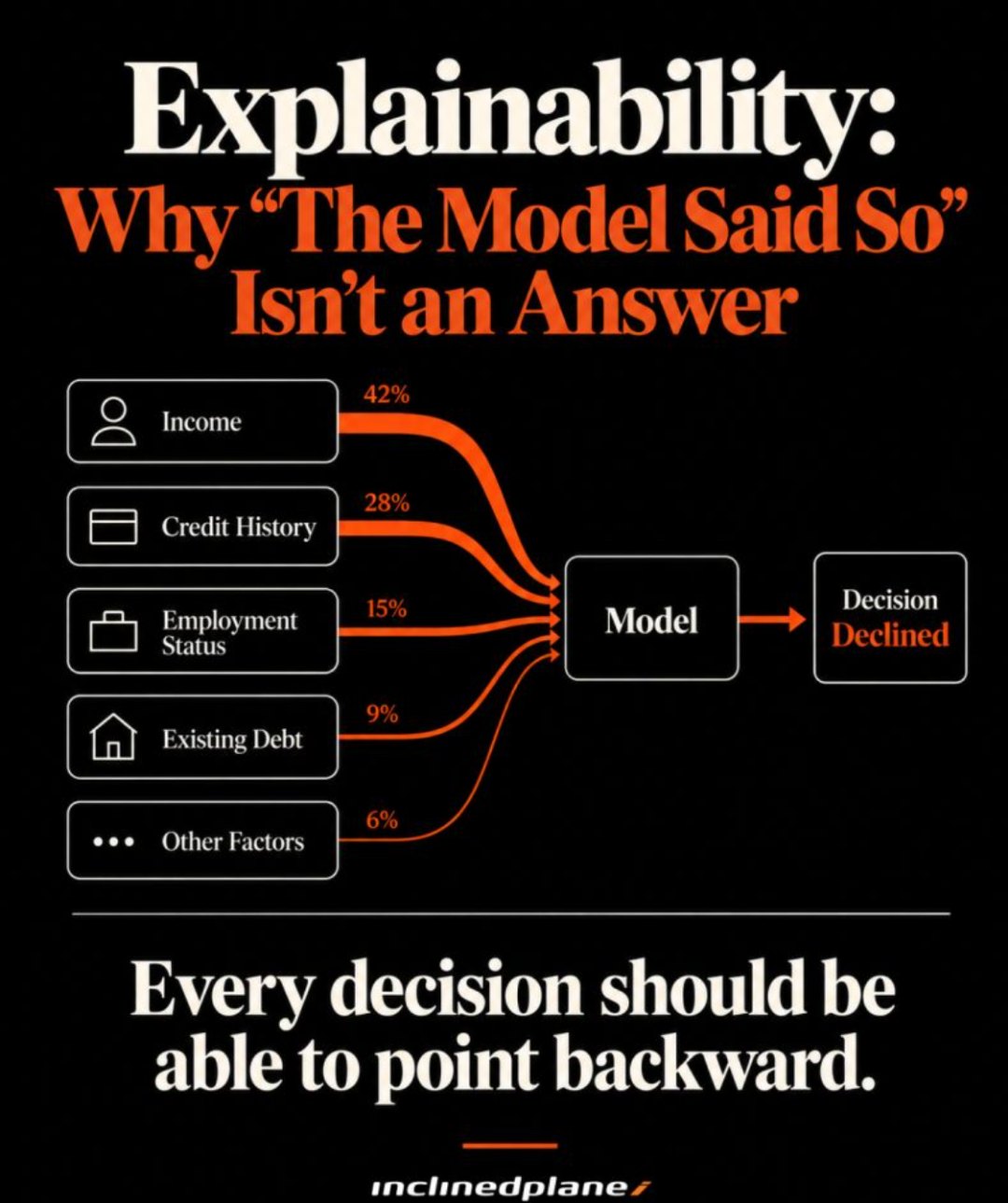
Every automated decision should be able to point backward: to the inputs it used, the logic it applied, and the data it learned from.
Who Actually Needs the Explanation
Most explainability efforts start with a technique and go looking for a use. It works much better the other way around: start with who needs to understand the decision, and what they will do with that understanding.
The affected person
Wants to know what drove the outcome and what they can change. "Your debt-to-income ratio exceeded our threshold" is useful. "Feature 17 contributed negatively" is not.
The operator
The credit officer, adjuster, or planner acting on the output needs enough context to agree, override, or escalate. Without it, they either rubber-stamp the model or quietly ignore it.
The auditor or regulator
Needs evidence that decisions are consistent, non-discriminatory, and based on permitted data, often months after the decision was made.
The engineering team
Needs to understand why the model failed on a particular case, whether a feature is leaking the target, or why behavior changed after a retrain.
These are four genuinely different explanations, with different levels of detail, different vocabulary, and different time horizons. A single feature importance chart in a notebook serves exactly one of them.
Reading the Diagram
The illustration at the top of this post shows a local explanation for a single, hypothetical loan decision. Five groups of inputs feed the model. Each carries a share of responsibility for the outcome: income 42%, credit history 28%, employment status 15%, existing debt 9%, and everything else 6%. The decision was a decline, and the explanation says income and credit history drove most of it.
That's genuinely useful. It's also easy to over-read. Attribution percentages describe how the model behaved, not how the world works. Income carrying 42% of the weight doesn't tell the applicant how much more income would flip the decision. When features are correlated, like income and employment status almost always are, attribution methods can split credit between them in ways that are mathematically valid but somewhat arbitrary. And the small "other factors" bucket can hide something important, such as a variable acting as a proxy for a protected characteristic.
An attribution chart tells you what the model paid attention to. It doesn't tell you whether the model should have.
The Explainability Toolkit
There is no single explainability technique. There's a toolkit, and each tool answers a different question with different failure modes.
| What it tells you | Watch out for | |
|---|---|---|
| Interpretable models | Exactly how each input maps to the output, by construction. Scorecards, linear and logistic regression, shallow trees, and generalized additive models. | Can give up accuracy on highly complex problems, though often less than teams assume on tabular business data. |
| Feature attribution | How much each input pushed one specific prediction up or down. SHAP and LIME are the best-known methods. | Unstable with correlated features, sensitive to the chosen baseline, and very easy to misread as causal. |
| Counterfactuals | The smallest change to the inputs that would have flipped the decision. | Must be limited to realistic, actionable changes. "Be five years older" is not advice anyone can follow. |
| Global explanations | What drives the model across all decisions, through feature importance and partial dependence. | Averages can hide subgroups where the model behaves very differently. |
| Decision logs and lineage | Which model version, which feature values, and which data were involved at the moment of decision. | Worthless unless captured at decision time. They cannot be reliably reconstructed later. |
Interpretable models
- What it tells you
- Exactly how each input maps to the output, by construction. Scorecards, linear and logistic regression, shallow trees, and generalized additive models.
- Watch out for
- Can give up accuracy on highly complex problems, though often less than teams assume on tabular business data.
Feature attribution
- What it tells you
- How much each input pushed one specific prediction up or down. SHAP and LIME are the best-known methods.
- Watch out for
- Unstable with correlated features, sensitive to the chosen baseline, and very easy to misread as causal.
Counterfactuals
- What it tells you
- The smallest change to the inputs that would have flipped the decision.
- Watch out for
- Must be limited to realistic, actionable changes. "Be five years older" is not advice anyone can follow.
Global explanations
- What it tells you
- What drives the model across all decisions, through feature importance and partial dependence.
- Watch out for
- Averages can hide subgroups where the model behaves very differently.
Decision logs and lineage
- What it tells you
- Which model version, which feature values, and which data were involved at the moment of decision.
- Watch out for
- Worthless unless captured at decision time. They cannot be reliably reconstructed later.
Start With the Simplest Model That Works
The most reliable way to explain a model is to use one that doesn't need a separate explanation. In an influential 2019 paper in Nature Machine Intelligence, Cynthia Rudin argued that for high-stakes decisions, teams should stop building black boxes and explaining them after the fact, and use inherently interpretable models instead. Post-hoc explanations are approximations of the model, and an approximation can be wrong in exactly the cases that matter.
In practice, for structured business data like credit applications, claims, and customer records, the accuracy gap between a carefully built interpretable model and a complex ensemble is frequently smaller than teams expect. The disciplined approach is to build an interpretable baseline first and make additional complexity earn its place with measurable improvement. Sometimes it does. Often the lift is too small to justify what you give up in transparency.
Explainability Is a Data Problem
Here's the part most explainability discussions skip. You cannot explain a decision if you cannot reconstruct the exact inputs that produced it. And in many organizations, you can't. The customer table has been updated since. The feature pipeline was refactored. The model was retrained last month and the old version wasn't kept. Six months later, when the complaint or the audit arrives, the evidence is gone.
Explainability starts long before the model, in the data infrastructure. At decision time, capture:
- ●A unique decision ID linked to the business event: the application, the claim, the shipment.
- ●The exact model version and a reference to the dataset snapshot it was trained on.
- ●The feature values as the model saw them at that moment, not as they appear in the warehouse today.
- ●The raw model output, and the business rule or threshold that turned that score into an action.
- ●The explanation generated at the time, plus any human override and the reason given for it.
Point-in-time correct feature stores, immutable decision logs, and end-to-end lineage aren't glamorous, but they are the foundation. Without them, every explanation is a best guess about the past.
What Regulators Already Expect
Explainability is no longer only a best practice. In the United States, lenders have long been required to give applicants the specific principal reasons for adverse credit decisions, and the Consumer Financial Protection Bureau has made clear that using complex algorithms does not exempt anyone from that obligation. In Europe, the GDPR restricts decisions based solely on automated processing that significantly affect people and gives individuals the right to meaningful information about the logic involved. The EU AI Act goes further for high-risk systems, which include credit scoring, with requirements around transparency, human oversight, and record-keeping.
This isn't legal advice, and the specifics vary by jurisdiction and industry. But the direction is unmistakable: if your system makes consequential decisions about people, you will be expected to explain them.
A Practical Explainability Checklist
- 01
Classify decisions by stakes
A product recommendation and a credit decision deserve very different levels of rigor. Tier your models so that effort goes where the consequences are.
- 02
Design the explanation before the model
Write the customer-facing reason codes, the operator view, and the audit report up front. They shape which features are acceptable and how they should be engineered.
- 03
Baseline with an interpretable model
Make every step up in complexity justify itself with measurable lift on the metrics that matter to the business.
- 04
Log every decision with full context
Capture inputs, model version, output, threshold, explanation, and overrides at decision time. Everything else depends on this.
- 05
Test explanations, not just predictions
Check stability, so similar cases get similar explanations. Check faithfulness to the model. And check whether operators and customers actually understand what they're shown.
- 06
Monitor for explanation drift
If the top drivers of decisions shift after a retrain or an upstream data change, someone should know before your customers or your regulator do.
The Bottom Line
Explainability isn't a feature you add to a model at the end. It's a property of the whole system: the data it learned from, the way decisions are logged, the choice of model, and the way outcomes are communicated to people. Organizations that design for it build AI that operators trust, customers accept, and auditors can sign off. Organizations that don't eventually discover that "the model said so" was never going to be enough.
At InclinedPlane, we build decision systems that can point backward, with the lineage, logging, and model design needed to explain every outcome to the people who depend on it.