Synthetic Data: The Useful Myth
Synthetic data gets pitched as a shortcut around every data problem. It is a genuinely useful tool, as long as you are honest about the one thing it can never do.
The Pitch Versus the Reality
Every few months a new wave of tooling arrives with the same promise. Not enough data? Generate it. Privacy team blocking access? Generate it. Only a handful of fraud examples in five years of transactions? Generate a hundred thousand more. Synthetic data is sold as the universal unblocker, the thing that finally separates AI progress from the slow, messy, regulated work of collecting real data.
The pitch isn't wrong, exactly. It's incomplete in a very specific way. Synthetic data is a powerful engineering tool, and we use it regularly. But it is a tool for working with knowledge you already have, not a source of new knowledge. Teams that understand that distinction get enormous value from it. Teams that don't end up with models that perform beautifully in testing and fall over the first time reality does something unexpected.
Synthetic data can only tell you what you already knew well enough to encode. Its value lives in the predictable parts of the distribution. Its danger lives in the interesting ones.
What Synthetic Data Actually Is
Synthetic data is artificially generated data designed to look and behave like a real dataset without containing the real records. That definition covers a surprisingly wide spectrum of techniques, and the differences matter for what you can safely use the output for.
Rule-based generation
Libraries and hand-written rules that produce realistic-looking names, addresses, IDs, and dates. Excellent for UI testing and schema validation. Carries almost no real statistical signal.
Statistical modeling
Fit distributions and correlations to real data, for example with Gaussian copulas, then sample new rows. Preserves column-level distributions and pairwise relationships reasonably well.
Deep generative models
GANs, variational autoencoders, diffusion models, and large language models. They capture far more complex structure, but they are harder to validate and can memorize training records.
Simulation
Agent-based or physics-based simulators that generate data from a model of how the world works. Common in robotics, autonomous driving, and supply chain planning. Only as faithful as the simulator.
All four share one property that the marketing tends to skip: the generator learned from something. Either it learned from your real data, or it learned from the assumptions someone wrote into rules or a simulator. Nothing comes from nowhere. Every synthetic dataset is a compressed, re-expanded copy of a prior belief about the world.
Why the Synthetic Grid Looks So Tidy
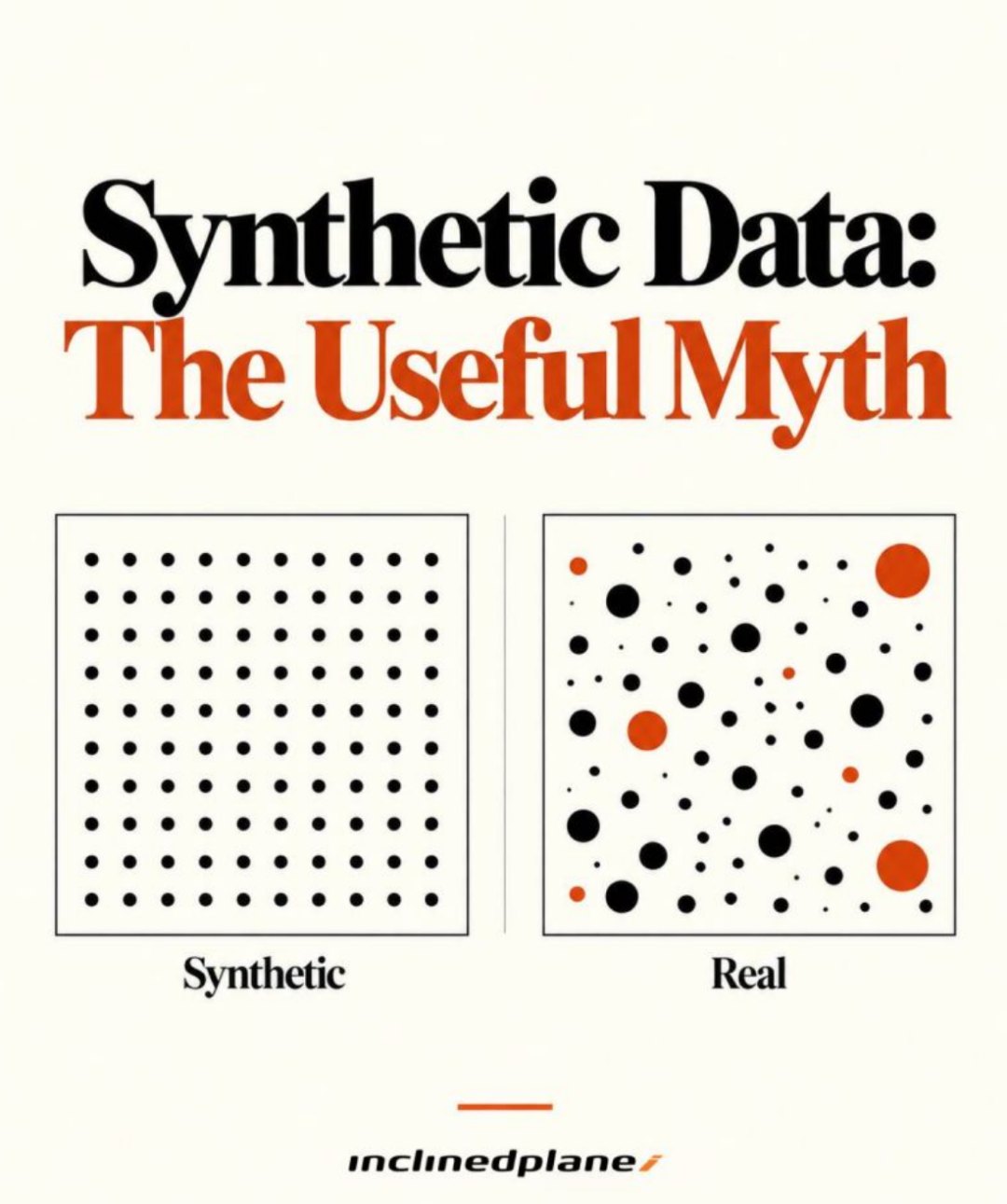
Look again at the illustration at the top of this post. On the left, a perfectly regular grid. On the right, real data: clustered, uneven, dots of wildly different sizes, and a few orange points that don't fit any pattern. That contrast is an exaggeration, but it captures something true about how most generators behave.
Generative models are trained to reproduce the typical. They are rewarded for capturing where most of the data lives, which means the dense middle of the distribution gets modeled well and the sparse edges get smoothed over. Rare combinations of attributes are underrepresented or disappear. GANs are known to suffer from mode collapse, where the generator settles on a narrow set of outputs that reliably fool the discriminator. Even well-behaved models drift toward the mean.
In business data, the edges are frequently where the value is. Fraudulent transactions, equipment failures, the small group of customers driving a disproportionate share of revenue, a sudden regional demand spike: these are precisely the events a generator sees least and reproduces worst.
The orange dots are the point. Fraud, failures, churn, rare diseases, and black-swan demand spikes are exactly the events that matter most, and exactly the ones a generator has the least evidence to learn from.
Where Synthetic Data Earns Its Keep
None of this means synthetic data is overhyped into uselessness. Used for the right jobs, it removes real bottlenecks. These are the use cases where we consistently see it pay off.
Development and test environments
Copying production data containing personal information into development environments is one of the most common compliance gaps we find. Schema-faithful synthetic datasets let engineers build and test pipelines against realistic volumes, shapes, and edge-case formats without ever touching a real customer record. This is the lowest-risk, highest-return use of synthetic data, and most organizations should already be doing it.
Privacy-conscious collaboration
Sharing data with a vendor, a research partner, or another business unit often stalls on privacy review. A well-generated synthetic version can let that work start while formal agreements are negotiated, or replace the need to share real records entirely. The caveat, which we'll return to, is that synthetic does not automatically mean anonymous. It has to be tested.
Rebalancing rare classes for training
When the event you're predicting occurs in a tiny fraction of records, models can learn to ignore it entirely. Oversampling techniques like SMOTE, which interpolates new minority-class examples between existing ones, and more sophisticated generative approaches can help a model see enough positive examples during training. The key word is training. The evaluation set must stay real.
Bootstrapping before data exists
A new product, a new market, or a new sensor deployment has no history yet. Synthetic data lets you build the pipeline, the dashboards, and a first version of the model so that everything is ready when real data starts flowing. It also makes load testing realistic: you can generate ten times your expected volume and find the bottlenecks before your customers do.
Scenario planning and stress testing
Simulation-based synthetic data is invaluable for exploring scenarios that haven't happened: a supplier outage, a pricing change, a tripling of demand. This works precisely because everyone knows the data is hypothetical. The assumptions are explicit, and the output is treated as a what-if rather than a fact.
Where It Fails Quietly
The failures of synthetic data rarely announce themselves. They show up months later as a model that underperforms in production, or a privacy incident nobody thought was possible. These are the patterns to watch for.
- ●Evaluating models on synthetic data. If the test set was generated from the same distribution the model was trained on, you are grading your own homework. Scores will look excellent and mean very little.
- ●Expecting it to reveal new patterns. A generator cannot invent a real relationship it never observed. Worse, it can introduce artifacts that look like patterns, which a model will happily learn.
- ●Ignoring drift. A synthetic dataset is a snapshot of the world at generation time. Customer behavior, fraud tactics, and supply chains move on. The synthetic data doesn't.
- ●Training on generated data recursively. Research published in Nature in 2024 showed that models trained repeatedly on the outputs of earlier models progressively lose the tails of the original distribution, a failure mode the authors called model collapse.
- ●Assuming privacy by default. Generative models can memorize and reproduce near-copies of training records, particularly unusual ones. Membership inference attacks can sometimes reveal whether a specific individual was in the source data.
Three Questions to Ask Before You Generate Anything
- 01
What decision will this data inform?
If the answer is a production decision about real customers, synthetic data can support development and training, but never final validation. If it's a test environment or a load test, the bar is much lower.
- 02
What did the generator learn from, and what did it miss?
Document the source data, its time window, known gaps, and how many examples of rare classes actually existed. A generator trained on 40 fraud cases has learned about 40 fraud cases, no matter how many rows it outputs.
- 03
How will we measure fidelity, utility, and privacy?
These are three separate questions with three separate tests. A dataset can look statistically identical to the source, be useless for the actual task, and leak real records, all at once.
Measuring Whether It's Good Enough
| The question | How to test it | |
|---|---|---|
| Fidelity | Does it look like the real data? | Compare column distributions, correlation matrices, and category frequencies against the source dataset. |
| Utility | Does it work for the job it was made for? | Train on synthetic, test on real. Compare performance against an equivalent model trained on real data. |
| Privacy | Could it expose a real person? | Distance-to-closest-record checks, membership inference testing, and differential privacy where the risk justifies the utility cost. |
| Coverage | Does it include the edges? | Check rare-class counts, extreme values, and segment-level distributions, not just overall averages. |
Fidelity
- The question
- Does it look like the real data?
- How to test it
- Compare column distributions, correlation matrices, and category frequencies against the source dataset.
Utility
- The question
- Does it work for the job it was made for?
- How to test it
- Train on synthetic, test on real. Compare performance against an equivalent model trained on real data.
Privacy
- The question
- Could it expose a real person?
- How to test it
- Distance-to-closest-record checks, membership inference testing, and differential privacy where the risk justifies the utility cost.
Coverage
- The question
- Does it include the edges?
- How to test it
- Check rare-class counts, extreme values, and segment-level distributions, not just overall averages.
Coverage is the lens most teams skip, and it's the one most directly tied to the failure modes above. A synthetic dataset can match the source on every summary statistic while containing almost none of the rare cases that the model most needs to get right.
Treat It Like a Data Product
The most avoidable synthetic data problems are operational rather than statistical. Synthetic rows end up in a production table. A test dataset gets reused for a purpose it was never validated for. Nobody remembers which version of the generator produced the data a model was trained on. The fix is the same discipline we apply to any other dataset.
- ●Tag every synthetic dataset in your catalog with its generator, version, source snapshot, and intended use.
- ●Keep synthetic and production data in separate schemas or accounts, with access controls that make mixing them a deliberate act rather than an accident.
- ●Regenerate on a schedule when source distributions drift, and re-run fidelity, coverage, and privacy checks every time.
- ●Require that every model trained with synthetic data is evaluated on a real, held-out dataset before it is released.
The Bottom Line
Synthetic data is a useful myth. Useful, because it unblocks development, protects privacy, balances training sets, and lets teams build before real data exists. A myth, when it's sold as a substitute for reality. It can make your known world bigger. It cannot show you the parts of the world you haven't seen yet.
At InclinedPlane, we help teams decide where synthetic data fits in their data and AI stack, and build the generation, validation, and governance around it so it accelerates the work without quietly undermining it.